
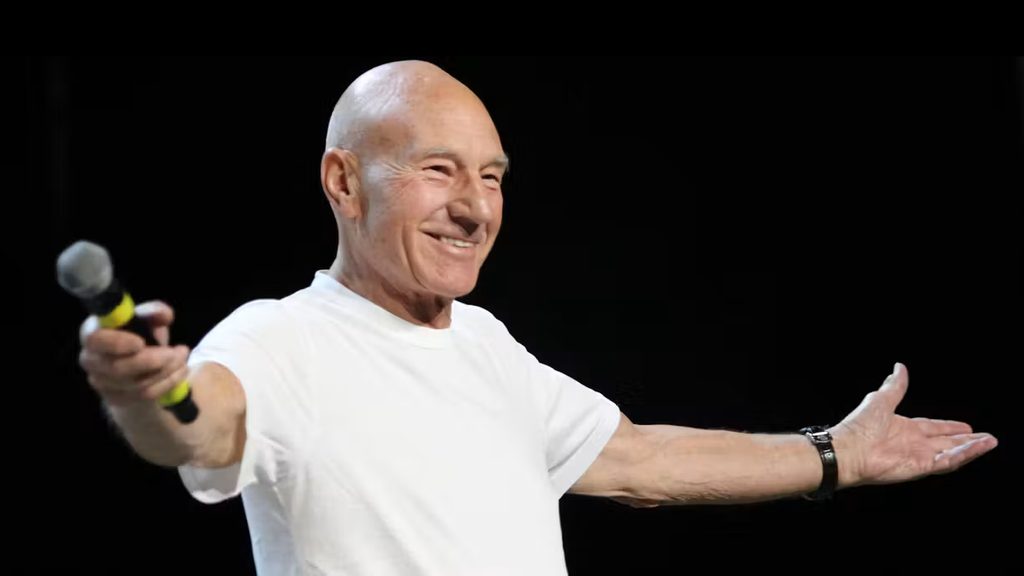
Gobsmacked. That’s how I felt when I learned that SIR PATRICK STEWART, our beloved Captain Jean-Luc Picard and Professor Charles Xavier, had passed away at the age of 86 on Wednesday. I was even more astonished to discover that Sir Patrick has suffered “a brief and poignant journey with Alzheimer’s disease and Lewy body dementia.” What a tragic way to go, I thought.
Then I thought: But, oh, how he lived!
Granted, Sir Patrick didn’t fly to space like his starship captain predecessor WILLIAM SHATNER did. Then again, Bill was never knighted by the Queen of England, so I think we can call it a wash.
But the fact is that both actors were consummate professionals and unbelievably gifted, and both were truly Renaissance men (and Shatner still is at 95, God bless him!). Patrick Stewart could hold an audience captive, entranced and delighted, for hours. I saw him do it multiple times at four different performances of his live, one-man production of CHARLES DICKENS’ A Christmas Carol—once in Pasadena, in San Diego, on Broadway, and in Hollywood. Each show was a masterpiece.
During the final performance on my above list, Sir Patrick’s voice started to give out toward the end of the first act. He battled his way through coughs, but ten minutes into the second act, after increasing struggles, it was obvious that the actor had contracted an illness, and try as he might, he couldn’t continue. He stopped the performance and humbly apologized to all of us. His disappointment seemed to be almost more than that of the rest of the audience combined. As an actor, he knew that the show must always go on. But he simply couldn’t. We gave him a standing ovation nonetheless, having watched his herculean efforts to try to finish. Bravo, sir, bravo!
I remember early in Sir Patrick’s convention appearances going to see him for the first time in Binghamton, NY. And if you have no idea where Binghamton is, that shows you how early it was, as it was a tiny con. In fact, I believe this was at the beginning of TNG‘s second season. Camera phones were still decades away, and Patrick (not yet a “Sir”) politely requested that no one record his presentation, either on video or a tape recorder. “I believe, as an actor,” he began, “that every performance is a secret, shared only between those on stage and their audience. It is recorded in memories only, with special nuances known only to those in attendance on that particular night or day.” Nearly forty years later, I still remember those words.
I also remember Patrick saying the following profound thing. “I mourn the death of words. Our beautiful language is contracting. Oh, certainly it expands with the addition of technical terms like megabyte and motherboard. But wonderful words like sagacity and widdershins are disappearing from a lack of use. This deeply saddens me, and please let me explain why…
“You see, ultimately, human beings do not have much that is truly interesting to say to each other. Oh, we occasionally come up with profound thoughts, but the majority of what we communicate to each other is rather mundane and pedestrian. However, when conveyed with a careful selection of somewhat obscure and compelling words, our thoughts can blossom into significantly more engaging and dynamic experiences for those to whom we are speaking. In my opinion, we need to hold onto these rapidly-disappearing and disused words simply because we owe it to each other to be less boring and more interesting!”
It’s a testament to Sir Patrick’s wisdom and profundity that I still remember what he said almost word for word. To this day, I endeavor to sprinkle a wider variety of vocabulary into my prose, and I thank that British thespian for inspiring me to do so.
I also recall seeing Sir Patrick at a number of conventions doing short renditions of Shakespeare. This was something he used to almost always do, preparing brief soliloquies from various plays before each convention appearance. Audiences always requested “To be or not to be…” from Hamlet, but he would politely demur, saying it was terribly overdone and too well-known. But one time in Baltimore, having not had time to prepare anything else, Sir Patrick agreed to the request. And while I’d heard that speech countless times, I never really got it until the moment Sir Patrick came to the point in the monologue where Hamlet says,
To die, to sleep;
To sleep: perchance to dream: ay, there’s the rub;
For in that sleep of death what dreams may come
When we have shuffled off this mortal coil,
Do you remember when Captain Picard mind-melded with Sarek and had to absorb the Vulcan’s turbulent thoughts and feelings? Remember how Patrick Stewart would shift abruptly from one emotion to another in this intense scene? Imagine that as I tell you about Patrick’s delivery of this part of Hamlet’s speech.
As Patrick said the words, “To die, to sleep;” his entire being was radiating relief, as though he were imagining a paradise, a final rest free of the stresses, fears, and chaos that was Hamlet’s unraveling world. Dying would be a merciful deliverance, a pleasant release from all of his troubles. And in that moment, the entire audience was connecting with that, feeling Hamlet’s heartfelt desire to escape the bonds of his tortured life. Suicide seemed like the natural, logical, inevitable choice compared to the pain and anguish of remaining alive.
And then Sir Patrick stopped. There was silence for a moment as his face shifted entirely, slowly and yet not, from a smile of relief to one of abject terror. You could see—FEEL!—the fear and uncertainty spread across his face and body. What could possibly have scared Hamlet so much to wipe away his peace and replace it with dread?
And then Patrick continued, “To sleep: perchance to dream…” He almost yelled the word “dream” as it utterly terrified him. “For in that sleep of death what dreams may come…” It was almost as if Hamlet was seeing death not as a release but rather a prison, to be haunted by dreams of the torture his life had become.
That shift in emotion was enough to let me know how truly magnificent an actor was Sir Patrick Stewart, beyond simply being Jean-Luc Picard or Charles Xavier. He was a man of his craft, throwing everything he had into each performance, whether in front of a camera, in a theater, or inside of a crowded hotel ballroom filled with Star Trek fans who likely had little knowledge or experience with the Bard or his legendary opus of plays. Sir Patrick gave his all every time in the hope that it would touch at least one person.
And in the case of that single moment in Baltimore when Hamlet’s emotions shifted in a matter of seconds, Patrick did touch someone. And I remain affected even to this very day.
And enterprises of great pith and moment
With this regard their currents turn awry,
And lose the name of action.
Soft you now, Sir Patrick. You have earned your rest in the undiscover’d country from whose bourn no traveller returns. You gave us so much, and now a part of you shall live on in the memories that you yourself helped to create in each of us.
Thanks for that magnificent tribute. I’ll add a quote from what was a magnificent performance in the “Inner Light” :
“Seize the time… Live now. Make now always the most precious time. Now will never come again.”