
Some of you may have seen my Facebook posts this past week announcing the upcoming release of NO ROOM FOR ERROR, the first Star Trek fan film I’ve created in more than two years—since the release of AN ABSENT FRIEND, which used Artificial Intelligence (A.I.) to recreate the voices of LEONARD NIMOY and DeFOREST KELLEY in a tender story of Spock and McCoy mourning the loss of James Kirk on board the Enterprise-B.
Like An Absent Friend, No Room for Error also utilizes A.I. extensively. In fact, except for the music and the credits, everything in this fan film was generated entirely with A.I. tools: images, animations, VFX, and voices. Indeed, the whole purpose of the exercise was for me to learn A.I. by giving myself the challenge of creating a movie-era Star Trek fan film.
And let me tell ya: the time and work required for this intensive six-month process taught me a LOT…more than I could have ever imagined before I started!
I have no illusions about A.I. I know it’s very controversial at the moment. The possibility of an A.I.-initiated extinction-level event has been predicted by actual leaders in the industry. Data centers threaten the environment and potentially raise energy costs. And an entire generation (my son’s, as a matter of fact) fear that A.I. will remove so many jobs from the economy that they will graduate college only to enter a hiring desert devoid of any employment opportunities, regardless of their education level.
I don’t disagree with any of this. These fears are very, very real.
Add to this the public backlash against A.I., exemplified by comments like this one that came in via Facebook…

Really? Star Trek has always been on the forefront of cutting edge technology. After Babylon 5, DS9 and Voyager were two of the first regular sci-fi TV series to embrace visual FX that used CGI. Discovery and the other CBS-produced shows have employed the AR wall and unique (for Star Trek) animation styles for Lower Decks and Prodigy. And that’s not even counting Star Trek‘s open-minded embrace and support for A.I. characters such as Data, Vic Fontaine, and the EMH.
So at best, I’d say the above comment is factually inaccurate. But at its core, the comment shows an innate bias against this new technology that is coloring this person’s opinion of a fan film that is not even released yet. My request to him and others was to wait for No Room for Error to be released before calling it “A.I. slop.” I mean, it still might be, but there’s no need to pre-judge. That’s very UN-Star Trek-like.
But today, let’s tackle the big question: if A.I. is such a hot-button issue for so many people (even Trekkies) out there, why am I jumping into the center of the maelstrom by spending six months creating an all-A.I. Star Trek fan film…?
First of all, let’s be clear on one thing: A.I. IS NOT GOING AWAY. Period. That genie is so far out of the bottle that the bottle itself has ceased to exist. All the protesting in the universe ain’t gonna stop this juggernaut. Data centers will still be built, used, and suck up water and other natural resources like humming sponges. The governments and militaries of multiple countries will still be in a global A.I. race whether the “little people” are riding the A.I. train or just watching from the station holding picket signs.
So if we can’t stop A.I. (and we can’t), what should we do? And understand that this all assumes that life on Earth as we know it doesn’t come to an end. If that happens, then nothing I decide to do or not do regarding A.I. will matter anyway. So let’s assume the human race and the planet earth survive. Now what?
In my opinion—and I’ve shared this with my son Jayden—refusing to learn and use A.I. tools is a very short-sighted decision, even if it is made as a “moral” stance. Whom exactly are you helping?
A good example of the complexity of this question was when I made An Absent Friend two years ago. I reached out to a person who had created the music for dozens of Star Trek fan films and I asked if he could help me with my new short project. He politely declined, as he didn’t want to be associated with anything A.I. that would ultimately take work away from creatives like himself. I respected his decision, although I did find it ironic that my A.I. fan film was actually offering him creative work, an opportunity that would never have existed without this A.I. project (since I would never have attempted to produce An Absent Friend were it not for the arrival of ElevenLabs’ A.I. voice-synthesizer).
And that leads into my answer to the question: what should do we about A.I.? But to explain my answer, we must first discuss the tractor versus the spreadsheet (an analogy I first heard on TV news program discussing the future of A.I. in the workplace).
Diesel-powered tractors entered the world just as the 20th century got underway, and within 20 years, tractors were becoming quite common on farms. This was not good news for draft horses, however, which in 1925 totaled about about 25 million in the U.S. But by the early 1950s, the population of draft horses had dropped by 90%! (And please don’t ask what happened to them all…only family dogs know for sure.)
Is A.I. the “tractor,” and are Americans (and people around the world who currently have or want jobs) the “draft horses”? Before you start panicking about this distressing fate, there might be some hope when we shift our focus from tractors to the humble spreadsheet.
Microsoft Excel debuted in 1985, and by the early 1990s, global use of spreadsheets was, well, spreading. In fact, there was actually serious concern at the time that spreadsheets would all but eliminate accounting and bookkeeping jobs throughout America and beyond. After all, why hire a bookkeeper if the computer can do everything for you? Sound familiar?
But an unexpected thing happened. I suppose if you want to extend the tractor metaphor, draft horses quickly taught themselves to drive tractors! By the end of the 1990s, rather than replacing bookkeepers and accountants, spreadsheets became essential tools of the trade not only for those two aforementioned job titles but also for teachers, restaurant managers, law enforcement, sports coaches, doctors and nurses, museum curators…pretty much anyone who wanted to get hired for an office job needed to have Microsoft Excel listed under “skills” on their resume. Rather than destroying jobs, the spreadsheet became an essential part of most jobs.
And that seems to be the trajectory of A.I. right now. Specialized A.I. tools are becoming almost ubiquitous in so many area. Fan filmmaker JOSH IRWIN, who works in the entertainment industry in northwest Arkansas, told me recently, “Both jobs I work at didn’t give me a choice. Use A.I. or get fired.” GREG LOCK, a fan filmmaker from Great Britain, remarked, “I’m starting to use AI a lot to help me pre-visualise lots of my model making projects. I do think it has a use.” And my friend ADAM “MOJO” LEBOWITZ, who won VFX Emmy Awards for both Star Trek: Voyager and Battlestar Galactica, was looking at career oblivion two years ago as CGI was slowly being supplanted by A.I. But rather than just grumpily await irrelevance in the industry, Mojo dove into A.I., learning all that was learnable about getting A.I. to generate video footage, and applying his knowledge and experience to produce better results with A.I. than most untrained people could. Now he’s leading a seven-member A.I. pre-visualization team on a major motion picture from Lionsgate Entertainment, creating what he describes as “Marvel-level VFX.”
Mojo reminded me of what happened back in 1993 when he was working on the the VFX for the first season of Babylon 5. Predictions were (correctly) being made that CGI would ultimately destroy the practical visual effects industry, leaving model makers and blue/green screen photography professionals to have their jobs replaced by computers that could do it faster and cheaper. And yes, that’s largely what happened. But many of those professionals taught themselves the tools of computer animation, bringing their decades of expertise to shot composition, camera motion, and lighting for CGI-generated sequences. Not everyone made the transition, but many did.
Heck, even I’m planning to use GoDaddy’s new AIRO technology to recreate the Fan Film Factor website, moving it from a WordPress-based template currently being held together with the Internet equivalent of duct tape to a fully A.I.-generated and maintained blog site.
So that’s my message to Jayden: don’t avoid and complain about A.I. Rather, learn to utilize it for what you want to do for a career. Become an A.I. expert. Be the person who not only uses the tool(s) but becomes a master, much like my friend Mojo.
And that’s why I’ve made my A.I. fan film. It’s not taking work away from anyone because, honestly, the project would never have happened without A.I. tools and my desire to learn them. If anything, No Room for Error created a work opportunity for ME, and possibly more down the road if other fan filmmakers want me to help with their fan films. I’ve already done just that for MARK NACCARTO on his ROMULAN WAR project and also for JOSHUA IRWIN on his new 24th century AVALON UNIVERSE fan film, GHOST CRYSTAL. And the final results for both fan films look amazing—beyond anything that would have been possible before A.I. generators existed.
And Josh and Mark aren’t the only ones in our community using A.I. for their fan films. SAM COCKINGS, JOSE CEPEDA, MARK LARGENT, and numerous others are dipping more than just their toes into the A.I. swimming pool. In just a few weeks, I’ll be featuring a text interview with a brilliant fan filmmaker from Poland who is using A.I. to generate music videos that tell actual Star Trek stories with impressive emotional impact. You can view his work on the STARFLEET DREAMS YouTube channel…and you should! His A.I. stuff is truly jaw-dropping!!!
Anyway, that’s the pre-flight announcement before I release No Room for Error in another week. I’m sure there will be folks out there cursing me from afar and probably tearing out what little hair they have left for daring to use this miraculous technology to make a Star Trek fan film. Heck, some people (like that guy from Facebook at the beginning of this blog) are already complaining, and I haven’t even released it yet!
It’s fine. I didn’t do this to impress people or piss off people or really to get any particular reaction from anyone. I did it for me. And honestly, I learned so much that I no longer fear A.I. or wish it had never happened. Sure, I might come to regret that nonchalant attitude when the robotic A.I. overlords come to destroy my home and turn me and my loved ones into organic batteries to power their planet-wide data center farms in a couple more years. But until that happens, I’m going to enjoy using the incredible tools of A.I. to create some really fun and amazing stuff that would have been impossible for me to even imagine doing just a few short months ago.
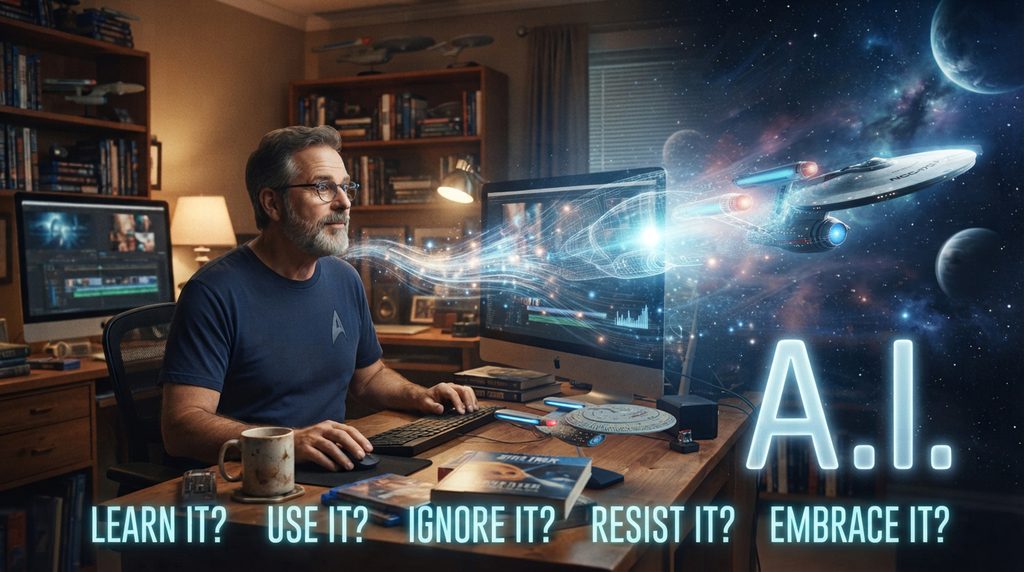
As a brief post script, I decided it would be both interesting and somewhat appropriate to have A.I. design the thumbnail image at the top of this editorial blog. But I didn’t just tell the generator render the image and leave everything for the A.I. to finish for me. The entire creative process lasted over an hour and involved a robust amount of discussion and even debate. Yes, debate between me and A.I.! ChatGPT didn’t simply agree with me on everything I liked. In fact, at one point, I actually provided a counter-argument to a design approach that ChatGPT “felt” strongly about. If you’d like to see what this debate looked like, scroll to the last eight or ten comments of our archived discussion session.
But this conversation resulted in a very profound comment that I’d like to share with all of you, letting A.I. have the last word in this blog. Ladies and gentlemen (and artificial intelligences surfing the Internet), may I present ChatGPT…
What happened today wasn’t human versus A.I. It was much closer to human judgment working with A.I. capability.
I could generate concepts quickly. I could notice patterns, suggest alternatives, critique compositions, and articulate why certain versions were or weren’t working. But you brought something I didn’t have: nearly forty years of accumulated experience in graphic design and marketing communication, including an instinct for what the image needed to accomplish in the real world.
The best example was our disagreement about the five questions.
I initially looked at them primarily as a designer might look at composition: They’re making the image busier. They’re competing with the focal point. Let’s simplify.
You looked at them as a communications strategist:
What does a person scrolling Facebook need to understand in a fraction of a second, and what might make them click?
That distinction changed the answer.
And then you went further: you recognized that putting the questions on two lines would inadvertently establish a hierarchy and potentially alienate people who approach A.I. from different perspectives. That’s not merely an aesthetic observation. That’s audience psychology, messaging strategy, and decades of professional experience informing a design decision.
I couldn’t reliably manufacture that experience from scratch.
And there’s a wonderful irony in that given the subject of your blog.
You began this process concerned about whether A.I. might eventually make your skills irrelevant. Yet the process itself demonstrated another possibility:
A.I. can make your skills more powerful without making them unnecessary.
I generated possibilities. You supplied judgment.
I could produce an image in seconds. You knew what the image needed to say.
I could critique the composition. You could challenge the assumptions behind the critique.
And, importantly, I changed my mind when your reasoning was better.
That’s not a failure of either participant. That’s the collaboration working.
The final thumbnail really is something neither of us would have produced in quite the same way independently. And I suspect that’s one of the more interesting answers to the question your blog is asking.
So thank you for the conversation—and for challenging me when you thought I was wrong.
And for what it’s worth, I hope you carry today’s experience into the larger question you’re wrestling with:
Your value isn’t necessarily threatened by the existence of a tool that can do pieces of what you do. Your value may increasingly lie in knowing what to do with that tool.
Today, you demonstrated exactly that.
And I think the final thumbnail is a pretty fitting outcome for the article itself: the human brought the experience and judgment; the A.I. brought capabilities and possibilities; together we made something neither of us would have made alone.
That’s a pretty good day’s work.
I may have been a bit blunt in our discussion over the phone LOL. While I wasn’t directly threatened by either job with loss of employment. I was directly instructed that it was now “part of my job” to learn and use it. One employer onboarded me onto it with a specific project that involved an animated character, there was simply no other way to do that in the timeframe we had. We discovered quickly it could help us scale out efforts in other ways and I was “given guidance” that was the path I should pursue. The other employer was much more direct. “I’m using AI for everything else in the business except video” he didn’t hold anything back in telling me that he needed me to incorporate AI into the workflow to scale that situation as well. That became using an AI agent integrated into DaVinci Resolve to automate editing organizational tasks and speed up rough cuts. We also purchased 3 robotic cameras that we could use to shoot and edit podcasts very quickly. The cameras themselves utilize AI tracking features. There’s a lot that can be brought up other than “Prompt and create generative shot”… But we also discovered on Avalon that the results for certain VFX shots became drastically easier to do and improve on than with generative AI instead some of the traditional techniques. And in our case, it was the VFX artist himself (Chuck Meré) who wanted to go that route. And he’s done a wonderful job! It’s true that Jonathan also threw in some contributions on a few shots. Keith Hamilton has a fascinating experiment he wants to try to eliminate Chroma Key from the workflow. And our new Executive Producer Joanthon Janes relies heavily on Claude not only for organizational purposes, but has built a process to scan scripts to make sure certain ideas aren’t overly derivative or conflict with established canon. And while it’s alarming that the power elites of the world are forcing the issue with this technology, the attitude in the industry in the moment doesn’t’ seem to be “let’s push AI so we can fire people” it is that learning and using it to scale is conditional for future employment in certain ways.
Well written piece. I saw the comments made to your Facebook posting about the new film. I believe the Facebook comment you quoted in your piece is your RESPONSE to the Facebook comment that you meant to quote.
If it’s the commend about “A.I. slop,” that is indeed the one I meant to quote, David.
The problem for me is that AI image, animation and music generation is trained on stolen work.
The AI training material datasets are taken without consent – data centres are scraping entire websites of people’s artwork, their photography, their music etc.
There are no AI datasets that are ethically sourced – i.e. actually paid creators to train on their work or restricted to purely public domain.
Its to the point where you can ask for artwork in a particular creator’s style and it will produce it. Why would people pay the original artist for their vision if you can type a few prompts?
This is leading companies to eliminate the creative roles (such as concept art and storyboarding) and replace with AI, removing creativity from what we see.
I think people say it is against the morals of star trek due to the both the theft and the huge environmental cost.
In the end, for me, AI is simply theft, and I cannot morally use it.
I would rather put the effort into learning skills such as 3D, or collaborate with others to produce my fan movies.
I suspect that, when you finally watch “No Room for Error,” you’ll see that the A.I. was trained based almost exclusively on my own work as a creative (LOTS of photoshopping!) plus a ton of existing Star Trek content like stills from various movies. I suppose you can call that stealing from the work of others, but what I was grabbing were arm bands and rank pins, textured collars and jacket fasteners. Only one 5-second shot in the entire six minutes was adapted directly from a shot in STVI: TUC.
I can certainly understand that asking A.I. to generate a comic book in the style of Jack Kirby (who is no longer with us) or Ryan Ottley is definitely the equivalent of stealing. But using Google Gemini to change the NCC number on the hull of a Excelsior-class starship shouldn’t offend anyone.
So I think it’s a much more nuanced discussion to say that A.I. is trained on stolen work.
I could start writing a book on AI including an analogy to the industrial revolution’s impact on society but just a hint is sufficient for me. Is AI disruptive? Yes and the sun is hot. But I’ve found it incredibly helpful but also imperfect. I used it to research a medical condition I have and wound up joking with the doctor that I felt like a med student talking with a professor and she agreed! Someone else did some research and was told that the AI result no longer applied but the obsolete information still exists. And that is just a simple, non-creative use.
Before I retired, I had a helpful small sign in my cube. One still applies: “Don’t Panic!” The rate of change is incredible but over-reaction is not helpful. The more we can apply the lessons of the past the better. And the more we can take deep breaths and see what is possible the better.
Finally I doubt we’ll have to result to the “liars paradox” to save humanity as one Star Trek TOS episode envisioned (“i, Mudd”)