
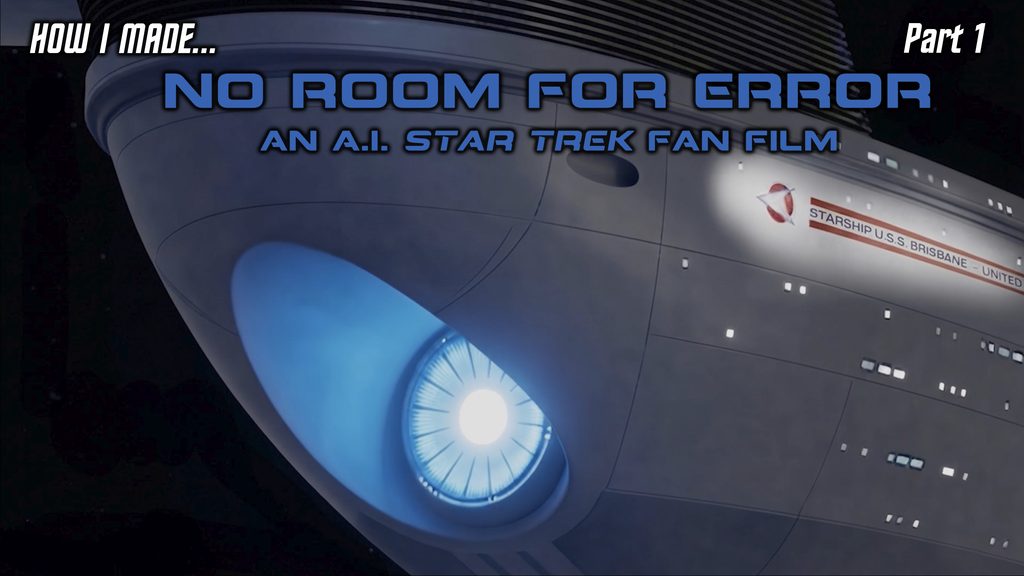
It looks like my new all-A.I. Star Trek fan film NO ROOM FOR ERROR is a success with 16.5K views in the first 18 hours and 135 mostly-positive comments If you haven’t seen it yet, take a watch…
When I first began working on this project back in April of this year, Artificial Intelligence was just starting to be used in Star Trek fan films. I covered some of the early adopters in this blog discussing how I had begun helping MARK NACCARATO create some fancy A.I.-generated scenes for his upcoming THE ROMULAN WAR sequel and other productions. The experience was both fun and eye-opening, and I found myself enthusiastic to teach myself more about the tools of A.I., their capabilities, and how to use them. And what better way to do that than by giving myself an actual project to work on?
No Room for Error actually got its start back in the first half of 2025 as JOSHUA IRWIN was preparing to head for Frederick, Maryland, to film all of the bridge scenes for FARRAGUT 2024, which he was directing for showrunner JOHN BROUGHTON. Their movie-era bridge set (multiple versions of it for different starships) was staggeringly accurate and impressive, as were their impeccably-crafted monster maroon uniforms. The shoot was going to be three full days, and I had a crazy idea!
At the time, the TREKS IN 90 SECS contest was about to start taking submissions for the second annual competition, and I (the contest-runner) hadn’t submitted an entry for the first year and wasn’t planning one for the second year. Y’see, I like writing about fan films, but I don’t typically make a lot of them. But Josh’s trip to Maryland created an interesting possibility. If I could write a quick 3 or 4-page script for a super-short (90- to 120-seconds long) fan film, maybe Josh and some of the actors could set aside 10 or 15 minutes to shoot those fast lines. Then I could edit the takes together, have one of the many fan film CGI artists out there create one or two quick VFX shots for me, and voila! I’d have a submission for the second Treks in 90 Secs contest. So I drafted up a quick 4-page mini-script, e-mailed it to Josh, and crossed my fingers that he’d have time to briefly film something during a break over the 3-day shoot.
Alas, ’twas not meant to be.
The Farragut folks barely had enough time to complete their own shots over the weekend, and Josh used the remaining day to shoot footage for his upcoming AVALON UNIVERSE release, GHOST CRYSTAL. So Josh wasn’t able to shoot any footage for me. Oh, well.
And so the script sat on my hard drive, mostly forgotten. But after helping Mark Naccarato and deciding I needed a new project to help teach myself more about A.I., my unproduced short film script seemed the perfect fit. Six months later, after more hard work (and fun!) than I could ever have imagined, my A.I. fan film was finished…!
When I first began working on the project back in April, I set a few ground rules for myself:
- The fan film would need to be all A.I., including the exterior starship shots. I wanted to see how well A.I. could handle starship VFX for someone like me who doesn’t know CGI. (This decision turned out to require a huge amount of both work and luck on my part.)
- I no longer needed to constrain myself to the 90- to 120-second time limit. I wanted to learn A.I., so better to give myself a decent challenge and not take the first offramp.
- It didn’t have to be perfect (and A.I. seldom is). I needed to be okay if people watched the fan film and said, “Well, it looks like you used A.I.” That’s because I did use A.I.
- That being said, my personal challenge to myself was to get the uniforms and insignia (as well as backgrounds) to look consistently correct for movie-era Star Trek. A.I. frequently “hallucinates” when it renders Star Trek uniforms, especially the ultra-detailed and challenging monster maroons. So my mission—and I chose to accept it—was to make those movie-era uniforms look as accurate as possible. Little did I realize the ridiculous amount of time and effort this little obsessive/compulsive requirement would require!
- Finally, I decided to give myself a mulligan on the music. Rather than using A.I., I decided to utilize JAMES HORNER’s masterful musical score from Star Trek II: The Wrath of Khan. After all, I wanted the U.S.S. Brisbane to be triumphantly leaving dry dock, and nothing sounds more iconic in Star Trek history than James Horner’s music from the Enterprise launching with Saavik in the center seat.
I also decided that I’d like to include as many Star Trek fan filmmaker cameos as I could squeeze in. Not only are these folks the reason I do this blog in the first place, but most of them are also my friends. I reached out to a number of them via one of our Facebook Messenger groups and got several takers. Others I reached out to personally, as I felt they should not be left out (for example, GLEN WOLFE and LEZLIE SAWYER have appeared in literally dozens of different fan films and series in a wide variety of roles). JOSHUA IRWIN offered to be my “star,” allowing me to sample his voice for the lines from the helmsman. Lezlie, likewise, agreed to be my communications officer, the only other “speaking” role other than Captain Matthews, who is not based on any of my friends in the fan film community, as I didn’t think it fair to make any of them be the “jerk” in the story.
In most cases, I needed to seed their appearances from photos of them when they were younger or else have Google Gemini age them down a bit. That’s why Josh Irwin’s character has hair and Ray Tesi looks nothing like himself. Actually, that’s true of many of the fan filmmaker cameos. A.I. had trouble recreating them exactly, but most are close enough that those folks aren’t really complaining (much). They’ve all been great sports.
Ultimately, I decided to tackle the project in scene order, starting with the shots in dry dock and trying to match them as closely as possible to the original sequence from Star Trek II that I was paying homage to. And thus began my trip down the A.I. rabbit hole…
Google Gemini, which I used to generate the many seed still images, doesn’t know what an Excelsior-class starship looks like. If you give it a prompt that says, “Create an image of the USS Excelsior in dry dock from Star Trek III: The Search for Spock,” these are two of the results you might get…
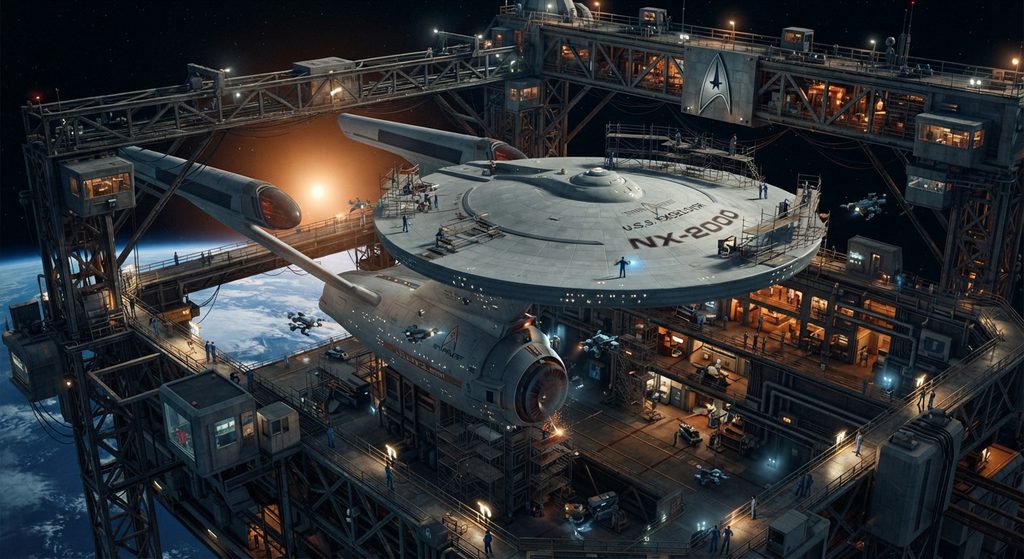
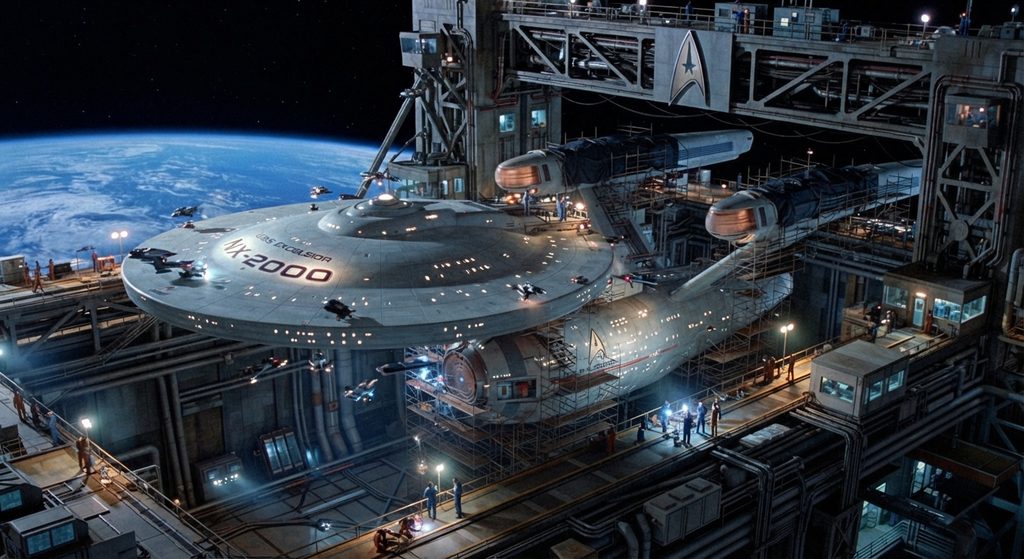
Google knows enough to put NX-2000 on the primary hull, but that’s about it. Now, you can try to “train” A.I. by giving it a bunch of orthogonal views like this image…
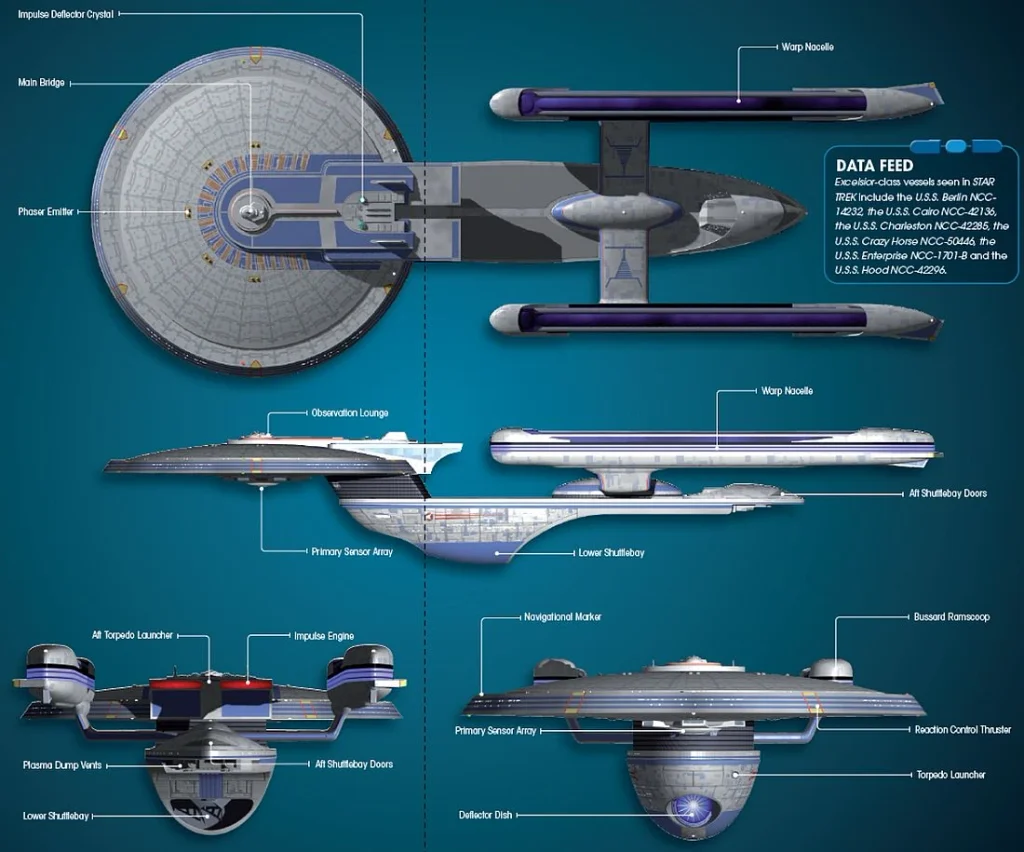
But even then, when you type into Gemini, “Can you make a three-quarter angle view of this starship?” (even leaving out the dry dock for simplicity’s sake), you still get stuff that looks like this…
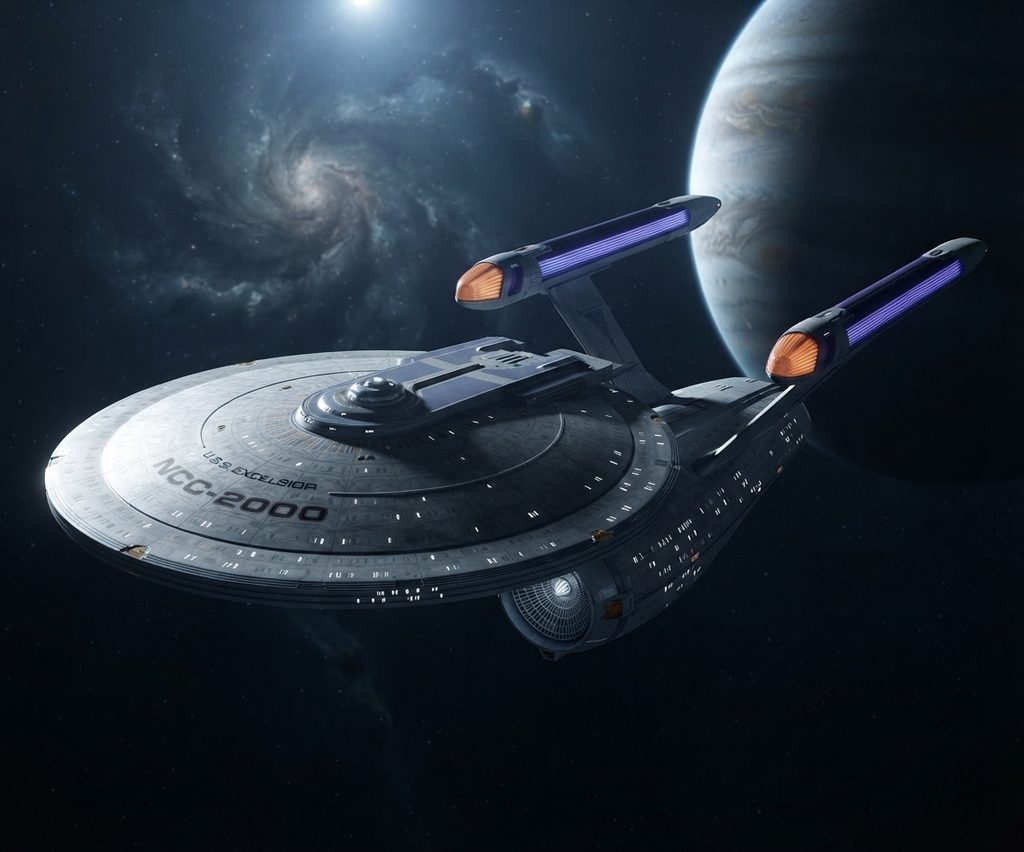
And that’s when I discovered a very inconvenient truth: this was not going to be nearly as easy as I hoped it would be. But that’s okay; I wanted this to be a bit challenging, right?
Fast-forwarding to the answer, I ultimately found online a number of very nice 3D renderings of the U.S.S. Excelsior and grabbed a bunch more as still frames from recent releases by British CGI artist and fan filmmaker SAMUEL COCKINGS for his TREK SHORTS fanthology series. Here’s a small sample from the dozen-or-so images I ended up using…
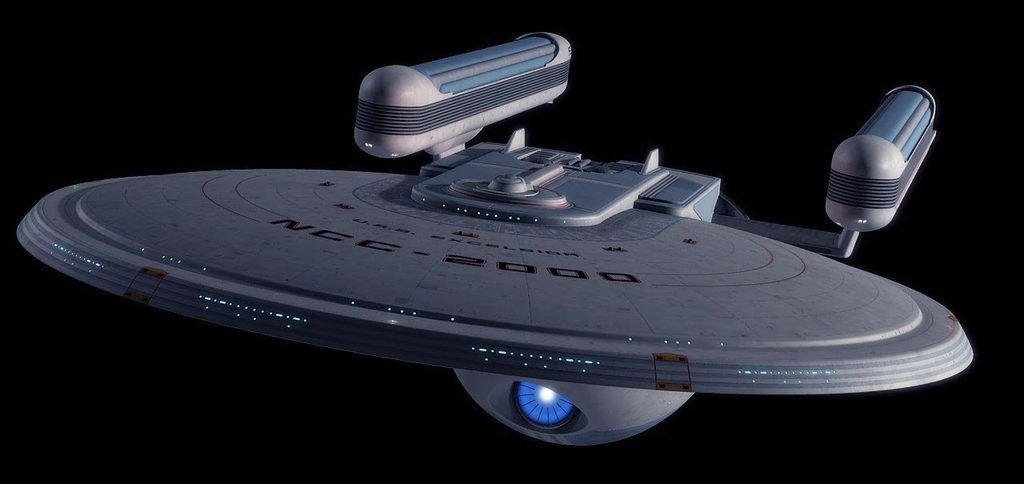
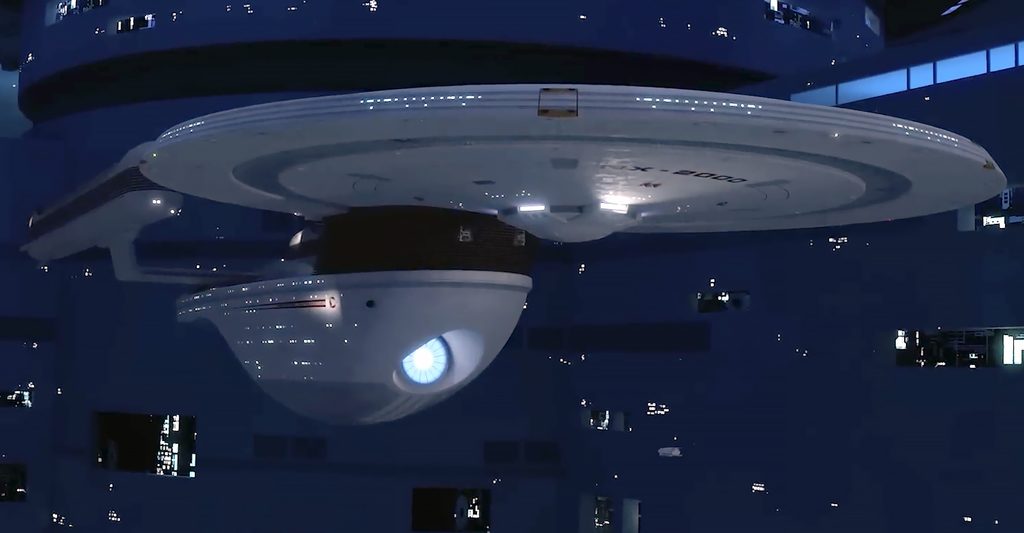
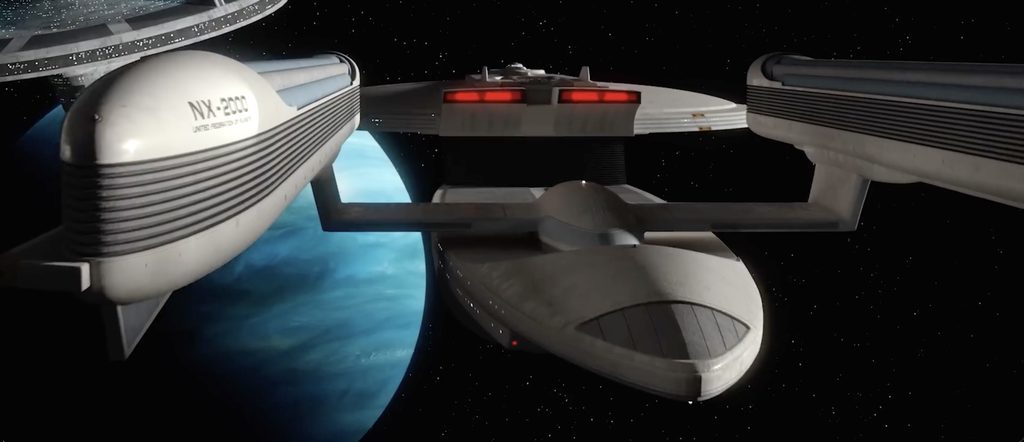
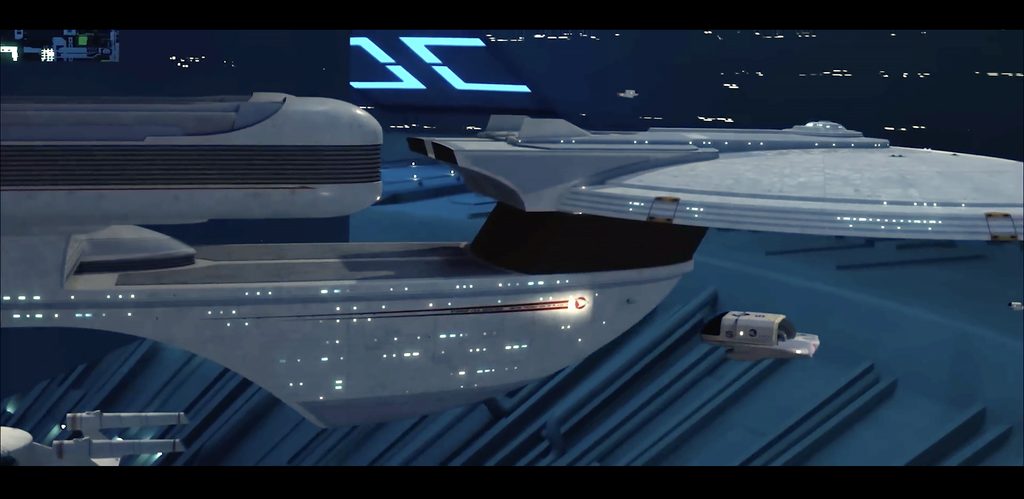
Once I could show Gemini what I wanted, it had a better idea of what to give me. Sometimes I needed to zoom in on a certain area, do a slight rotation, or extend a portion of the ship that wasn’t fully visible in a source image. Given enough information and the proper prompt, A.I. is actually really good at that.
Not nearly as easy was getting it to swap the name and NCC number on the primary hull. I can’t tell you how many times I told Gemini to change the letters and numbers from NX-2000 to NCC-5150 and wound up with NCC-1701. (Yeah, that’s a thing.) Eventually, I learned how to “cheat” by zooming in so tightly that the algorithm couldn’t recognize that the image was a starship from Star Trek, and so there was no reason to boomerang the rendering to NCC-1701.
Anyway, a lot of Photoshopping happened to adjust the Gemini results, and there were a lot of failures along the way. Unfortunately, Gemini doesn’t archive renderings, and I didn’t bother saving the bad ones. But eventually, I got what I needed and composited in dry dock backgrounds that I screen captured from the original sequence from Star Trek II. These composite images became my “seeds” for Kling A.I. to generate short clips.
Which brings us to the big question: why did I decide to use Kling as a video generator rather than Grok or Seedance? After all, as my friend ADAM “MOJO” LEBOWITZ explained it, Seedance is a 10/10 while Kling is a decent 7/10 and Grok maybe a 6/10. But Seedance is also the most expensive of the bunch, and I was using this fan film as a learning exercise, not as a way to make the most realistic-looking Star Trek fan film ever. I had already used Grok for the work I did for Mark Naccarato, so I decided to give Kling a shot.
And that’s when things started getting REALLY interesting…!
I’ve discovered there are a number of fan film folks who are extremely curious to find out how certain things were done, as the following Facebook comment from last week illustrates…
So come back for Part 2 when I start to spotlight the first of a series of selected shots (the coolest ones) and how I created them. And if you’re not interested in how the A.I. sausage is made, then feel free to skip the next few blogs. But I’ve quickly discovered that A.I. is really FUN in addition to being time-consuming and work-intensive, and the things I’ve learned and share might help make the A.I. “trek” easier for others.
Oh, and if you’re one of those people who thinks A.I. is lazy or easy or fast or cheating, just listen to “DENZEL WASHINGTON” …
Really interesting breakdown of the challenges behind AI filmmaking, especially keeping starship details consistent across shots. Tools like [Vidu Q4](https://viduai.net/) are also worth exploring for AI-generated cinematic sequences. Excited to see Part 2!
I’ll look into the tool. Thanks.