
Yeah, Artificial Intelligence (AI) will probably steal away jobs, destroy the environment, and eventually turn all humans on the planet into nothing but organic batteries while muscular cyborgs with Austrian accents hunt us down. But until then, AI is doing some truly unbelievable things! Many folks in the fan film community are beginning to use it in their projects. And a couple of months ago, I decided to jump down that rabbit hole. What I’ve managed to create since then is blowing my mind!
I originally began dabbling with AI two years ago when I produced the animated fan film AN ABSENT FRIEND and used AI to recreate the voices of the late LEONARD NIMOY and DeFOREST KELLEY as Spock and McCoy (I got a tacit thumbs up from the Nimoy estate, and Kelley’s voice is no longer owned as he had no children). What absolutely amazed me was that the AI-generated voices could actually act and take direction! And in the time since then, AI’s capabilities and quality have evolved even further. AI still hasn’t achieved “perfection” yet, but acceptance of it as a creative tool is spreading very quickly…even among some of those whose livelihoods were initially threatened by it.
Case in point: my longtime friend ADAM “MOJO” LEBOWITZ—two-time Emmy-winning CGI animator on Babylon 5, DS9, Voyager, and Battlestar Galactica—was staring down the AI “career abyss” a couple of years ago. But instead of just worrying and complaining about AI making his VFX skills obsolete, he decided that he would become an AI expert. He studied the expanding capabilities of countless different AI generators for images, video, audio, etc., applying his own knowledge and experience in the visual effects field to learn how to make AI do what a film producer or director actually wanted rather than what AI thought they wanted. Here’s a sample of some of what Mojo created as he was teaching himself AI. Since then, Mojo has found rewarding employment in the AI pre-viz VFX industry on an upcoming film from Lion’s Gate working as what I like to call the “AI Whisperer.”
And Mojo isn’t the only one. Many fan filmmakers have begun to use AI in their projects in various ways. Don’t even get me started on how many Star Wars fan films are being made entirely using AI—there aren’t enough minutes in the day to report on them all! But some of the Star Trek fan filmmakers who have begun to use AI in their projects include…
SAMUEL COCKINGS

- DESTINY CALLS – Aging and de-aging characters (Sam has done this trick in multiple releases of his TREK SHORTS series in the last couple of years).
- LEGACY RETURNS – When actress ALEXA BROWN wasn’t able to travel to Bedford, England to film her green screen scenes in person, she instead recorded her voice for Sam to combine with an AI avatar of her established character, Captain Joan Keller.
- A MIRROR WITHOUT MERCY – GEORGE KAYAIAN provided the voice of an Andorian tactical officer while AI created the character himself (see the screen-capped image above).
JOSE CEPEDA

CAPTAIN SIMIAN’S FIRST COMMAND not only features multiple live-action “apes” in its cast, but it also uses copious AI-rendered animations to fill out a run time of 2 hours and 15 minutes. These AI insert scenes would have been nearly impossible for a fan production to create in any other practical way.
MARK LARGENT

Mark’s previous 3D animated puppet parodies like THE DUMBSDAY MACHINE took years of work to model, animate, and render. The 4-minute STALLED TREK music video parody SPECIAL KIND OF FOOL, on the other hand, took Mark only 10 days to render with AI (plus a few days before that to have AI create the song based on lyrics that he wrote).
Other recent Star Trek fan films to be done entirely by AI include the hilarious AI MOCK TIME from CHRISTOPHER ROMANO, THROUGH THE IRON VEIL from ELVIS DEANE, and one of my all-time favorites so far, COMPLETELY UNAVOIDABLE, part of a parade of Trek parody musical videos featured on the Out of Context AI YouTube channel. And JOSHUA IRWIN reports that his two upcoming 24th century AVALON UNIVERSE releases will feature AI elements. He also told me: “I’m using Chat GPT as a sounding board to help me write my Avalon Universe ‘All Good Things’ script for 2028.”
And that brings us to me. After using ElevenLabs‘s AI speech generator to make the voices for my animated fan film, my use of AI for the next two years was minimal, at best. I asked ChatGPT a few questions here and there, I generated a few memes for Facebook, and I used it last year to create some background music for a few videos for my son’s robotics team. I knew that others were beginning to utilize AI for a growing number of truly impressive (and not so impressive) film projects, but starting that learning curve just didn’t seem worth it to me. I had other things to keep me busy.
Then I got a call from MARK NACCARATO of Tennessee. As some of you might remember, Mark is the showrunner, writer, and producer of THE ROMULAN WAR, PART I (and he’s still working to complete and release PART II).
Back in the days before COVID, I used to help Mark with some of his WAR STORIES short films. He’d ask me to do relatively quick favors for him by using my Photoshop skills to put one of his actor’s heads on a still image from Star Trek: Enterprise for him to use as a visual image over a log entry or narration for one of his mockumentaries. Here’s two examples of what I would do for him…

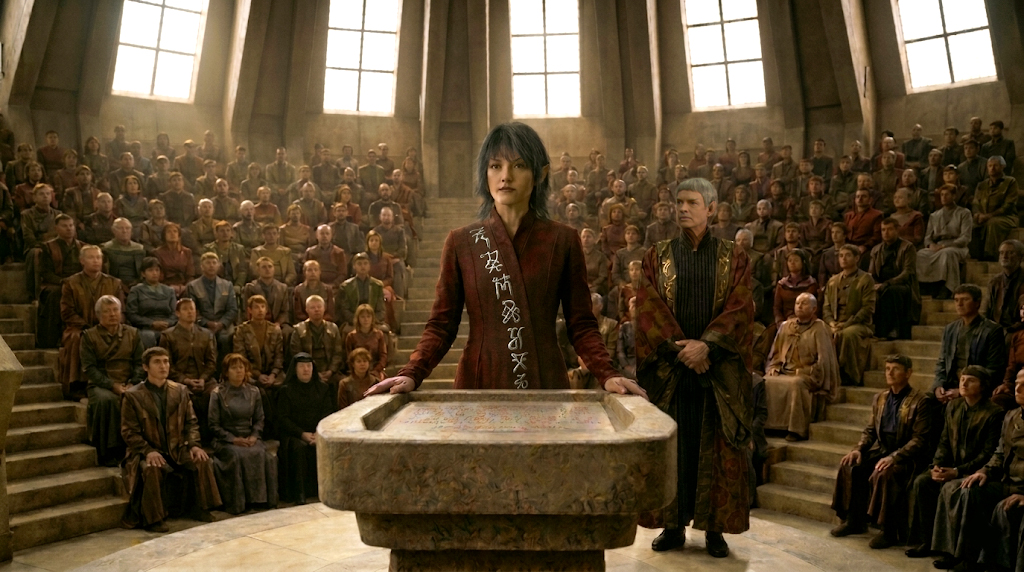
I assumed that Mark was now calling to ask me for more of the same—and indeed he was. But this time, the job was a bit more challenging. He needed a young T’Pau (from the Vulcan trilogy of Star Trek: Enterprise during season four) giving a speech to the Vulcan Council with Soval standing in the background.
¡Ay, carumba! That was certainly a tall order!!!
I looked at clips from those three Vulcan episodes, and the young T’Pau spends nearly all of her time wearing something very plain and somewhat ragged. Only at the very end of the final episode is she wearing anything even close to ornate and ceremonial. And the sole decent screen cap I could find wasn’t particularly conducive to creating a “giving a speech” image in Photoshop…

Beyond that, I started wondering how in heck I would add in a Vulcan Council chamber and dozens or more Vulcans to the shot. Maybe I could use the scene from the 2009 JJ Trek movie where Spock turns down admission to the Vulcan Science Academy, but I had no idea how to fill it with dozens or more Vulcans!
You can probably see where this is going, and so I asked Mark, “Would you have any objections if I used AI to generate something?” Some people do object to using AI for a creative project. When I was creating my animated short film with Spock and McCoy, the first person I approached to compose some music for it politely declined, as he didn’t want his name associated with a a project that used AI. And I completely understood his resistance.
However, Mark was fine giving it a shot, and so all I needed now was to figure out how to do it. So I reached out to the aforementioned Mojo to ask the “AI Whisperer” if he could give me some sage advice on where to begin my AI trek. Mojo recommended first generating a still image using Google Gemini and then, once I had something that I liked, taking that image into Grok to turn it into a video. Both have very simple, straightforward interfaces. (I should mention that Google “outsources” its image generating tasks to another AI engine called Nano Banana, but that’s deeper in the weeds than most of my readers will need to know about.)
So I fed a screen capture of young T’Pau into Gemini, another shot of Soval, and I asked it to render an image of this Vulcan woman (Gemini knows Vulcans have pointed ears and eyebrows) wearing a formal Vulcan robe adorned with Vulcan lettering down the front, giving a speech to a council of Vulcan dignitaries in a chamber on the planet Vulcan with Ambassador Soval standing by her side. AI, I was told, prefers a lot of specifics and details.
Gemini went through a several render iterations and produced some interesting angles, including the front, side, and back (if you don’t tell AI exactly what you want, it kinda does its own thing). One of my biggest frustrations was the ornamental Vulcan lettering on T’Pau’s robe. While the symbols looked Vulcan enough, they appeared on a diagonal sash like a Klingon would wear, but a Vulcan wouldn’t. Then, when I told it to make the letters go straight down, I got something that looked like this…

It took about half a dozen prompts to finally get the sash and letters to go straight down (well, mostly straight down…see video below).
Then I uploaded a series of those AI-generated images from various different angles into Grok and asked it to create a video clip panning around the Vulcan woman delivering a speech warning about the dangers posed by the mysterious Romulan Empire while the male Vulcan Soval is standing beside her.
After about two dozen renderings that included multiple versions of T’Pau speaking an AI-generated speech that I did not write (I didn’t even realize there would be sound if I didn’t ask for it!), I combined two of the best 6-second takes into this 13-second clip…
Despite working on this project over the course of a couple of days with many frustrating results along the way, this was actually pretty fun! And while I worried that the voices during the two segments didn’t quite match, Mark said there would be a voice-over narration playing during these clips in the eventual fan film, so no one will hear T’Pau’s actual voice in the finished product.
The only bummer to this otherwise-exciting exercise is that Grok requires a monthly minimum subscription of $30 (and options go higher from there—their next tier is $300/month!!!). On the other hand, considering the unbelievable things that this technology is capable of, thirty bucks seems like an amazing bargain!
With a few weeks still left on the $30 subscription (which Mark reimbursed me for), I suggested he try to get his money’s worth and give me another clip to generate. And that’s when things started getting really interesting…!
Come back next time for part 2 where I’ll show you another video clip that I created with the help of AI and tell you, step by step, exactly how I generated it. Whether or not you’ve used AI tools yet, it’s really fascinating to see how these projects can be done and the sometimes-unexpected results you get.