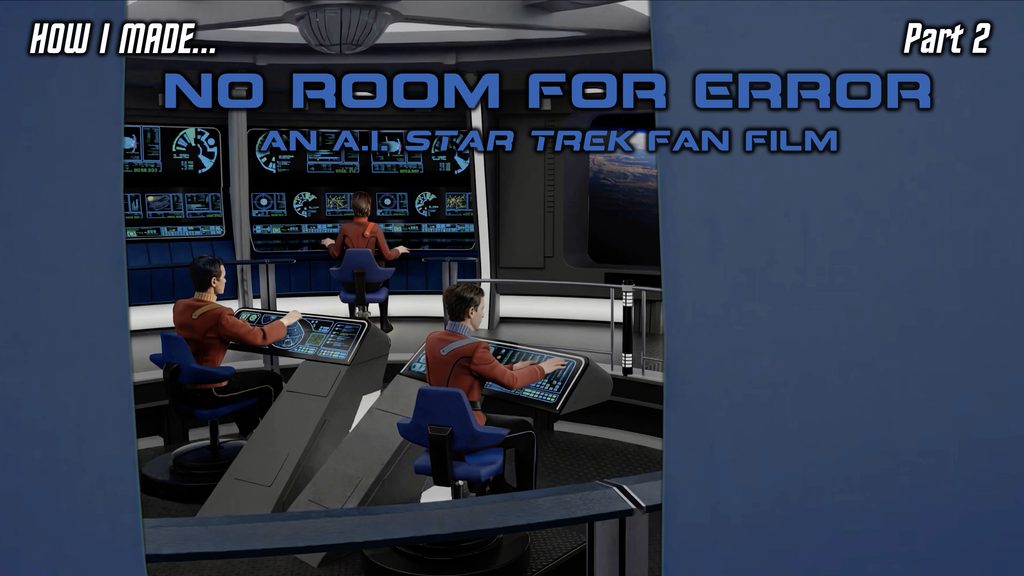
How I made my ALL-A.I. Star Trek fan film NO ROOM FOR ERROR… (feature, part 2)

Last time, I premiered my new all-A.I. Star Trek fan film, NO ROOM FOR ERROR, which took me nearly six months of many long days and nights to complete. The purpose of the project was to teach myself the tools of Artificial Intelligence for filmmaking by presenting myself with the task of actually creating a short Star Trek fan film. And to make things even more challenging, I decided the setting would be an Excelsior-class starship during movie-era Trek—some of the most difficult uniforms and set backgrounds for A.I. to tackle correctly and not screw up!

If you haven’t seen the short film yet, here it is…

I forgot to mention in Part 1 that the original title of my script was CLEAR ALL MOORINGS. And that title nearly stuck. I was working on the closing credits when I realized that simply putting the title at the end of the fan film wouldn’t work in keeping the “punchline” secret. And that was because the YouTube page would show Clear All Moorings as the title right there under the video the entire time. Not wanting to give away the gag, I decided at almost the last minute to change the title to No Room for Error.

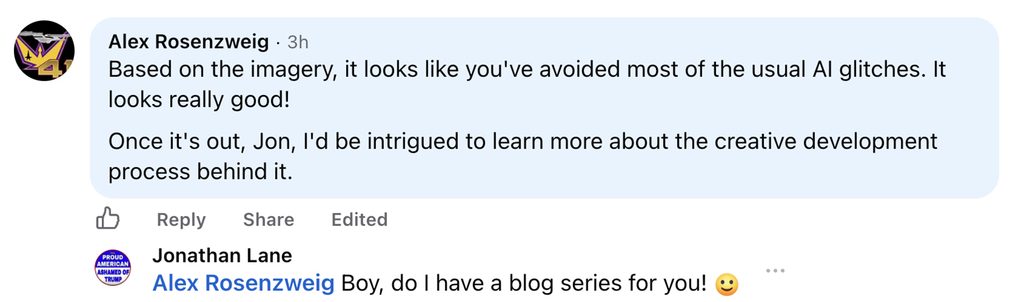
The fan film was too short to create a decent trailer without revealing too much, so in the week and a half leading up to the release on YouTube, I posted about two dozen still images to Facebook. This resulted in a number of comments like this one…
So I’ve decided to do a deep-dive into how I created some of the cooler shots for this fan film and how I managed to avoid some of the most common A.I. failures when it comes to rendering movie-era Star Trek. If that’s not your thing, then feel free to skip my next several blogs. I’ll be writing them specifically to help others, as I’ve learned that generative A.I. artists seldom keep their “tricks” secret and instead openly share the methods they used to achieve their results.

When last we left off, I had discovered that I needed to find actual stills of the USS Excelsior and adjust those—using a combination of both Google Gemini‘s free A.I. engine for generating images plus TONS of Photoshopping (often repeatedly for the same still). Then the time came to animate the lights turning on for the opening sequence. My tool of choice: Kling A.I. in order to learn what it could do. And it could do a LOT!

It could also screw up a lot…

Continue reading “How I made my ALL-A.I. Star Trek fan film NO ROOM FOR ERROR… (feature, part 2)”
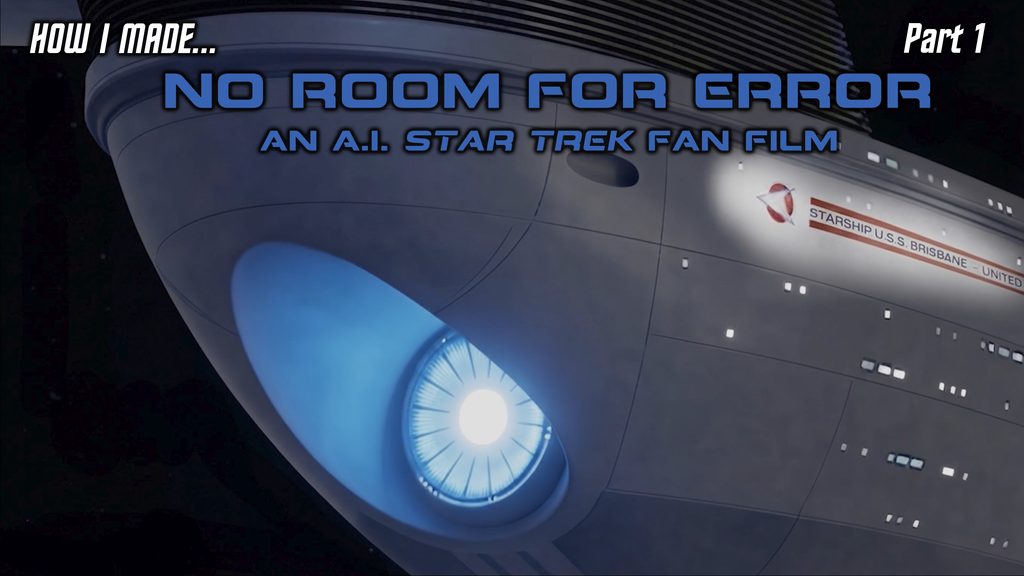
How I made my ALL-A.I. Star Trek fan film NO ROOM FOR ERROR… (feature, part 1)

It looks like my new all-A.I. Star Trek fan film NO ROOM FOR ERROR is a success with 16.5K views in the first 18 hours and 135 mostly-positive comments If you haven’t seen it yet, take a watch…

When I first began working on this project back in April of this year, Artificial Intelligence was just starting to be used in Star Trek fan films. I covered some of the early adopters in this blog discussing how I had begun helping MARK NACCARATO create some fancy A.I.-generated scenes for his upcoming THE ROMULAN WAR sequel and other productions. The experience was both fun and eye-opening, and I found myself enthusiastic to teach myself more about the tools of A.I., their capabilities, and how to use them. And what better way to do that than by giving myself an actual project to work on?

No Room for Error actually got its start back in the first half of 2025 as JOSHUA IRWIN was preparing to head for Frederick, Maryland, to film all of the bridge scenes for FARRAGUT 2024, which he was directing for showrunner JOHN BROUGHTON. Their movie-era bridge set (multiple versions of it for different starships) was staggeringly accurate and impressive, as were their impeccably-crafted monster maroon uniforms. The shoot was going to be three full days, and I had a crazy idea!

At the time, the TREKS IN 90 SECS contest was about to start taking submissions for the second annual competition, and I (the contest-runner) hadn’t submitted an entry for the first year and wasn’t planning one for the second year. Y’see, I like writing about fan films, but I don’t typically make a lot of them. But Josh’s trip to Maryland created an interesting possibility. If I could write a quick 3 or 4-page script for a super-short (90- to 120-seconds long) fan film, maybe Josh and some of the actors could set aside 10 or 15 minutes to shoot those fast lines. Then I could edit the takes together, have one of the many fan film CGI artists out there create one or two quick VFX shots for me, and voila! I’d have a submission for the second Treks in 90 Secs contest. So I drafted up a quick 4-page mini-script, e-mailed it to Josh, and crossed my fingers that he’d have time to briefly film something during a break over the 3-day shoot.

Alas, ’twas not meant to be.

The Farragut folks barely had enough time to complete their own shots over the weekend, and Josh used the remaining day to shoot footage for his upcoming AVALON UNIVERSE release, GHOST CRYSTAL. So Josh wasn’t able to shoot any footage for me. Oh, well.

And so the script sat on my hard drive, mostly forgotten. But after helping Mark Naccarato and deciding I needed a new project to help teach myself more about A.I., my unproduced short film script seemed the perfect fit. Six months later, after more hard work (and fun!) than I could ever have imagined, my A.I. fan film was finished…!

Continue reading “How I made my ALL-A.I. Star Trek fan film NO ROOM FOR ERROR… (feature, part 1)”