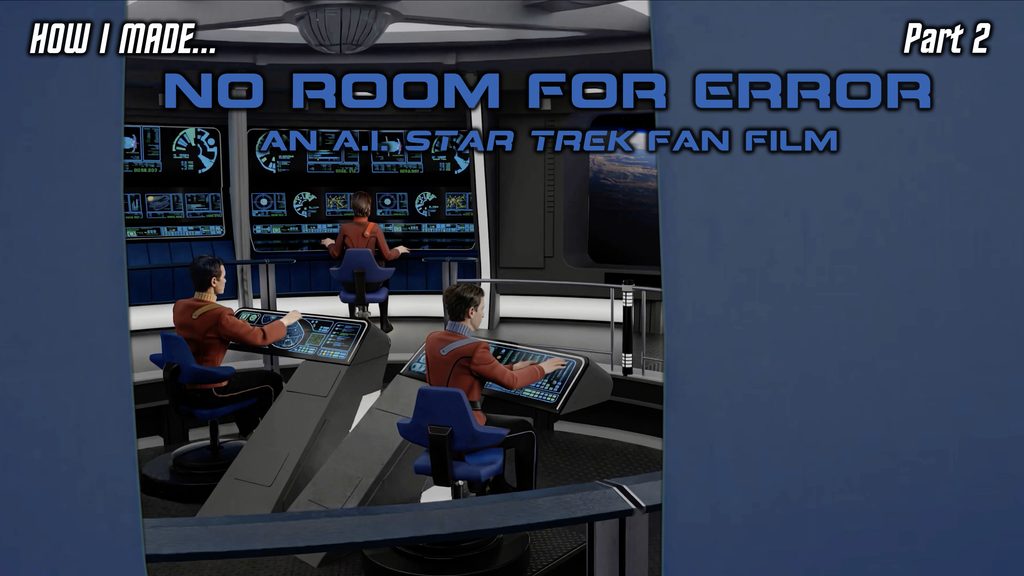
Last time, I premiered my new all-A.I. Star Trek fan film, NO ROOM FOR ERROR, which took me nearly six months of many long days and nights to complete. The purpose of the project was to teach myself the tools of Artificial Intelligence for filmmaking by presenting myself with the task of actually creating a short Star Trek fan film. And to make things even more challenging, I decided the setting would be an Excelsior-class starship during movie-era Trek—some of the most difficult uniforms and set backgrounds for A.I. to tackle correctly and not screw up!
If you haven’t seen the short film yet, here it is…
I forgot to mention in Part 1 that the original title of my script was CLEAR ALL MOORINGS. And that title nearly stuck. I was working on the closing credits when I realized that simply putting the title at the end of the fan film wouldn’t work in keeping the “punchline” secret. And that was because the YouTube page would show Clear All Moorings as the title right there under the video the entire time. Not wanting to give away the gag, I decided at almost the last minute to change the title to No Room for Error.
The fan film was too short to create a decent trailer without revealing too much, so in the week and a half leading up to the release on YouTube, I posted about two dozen still images to Facebook. This resulted in a number of comments like this one…
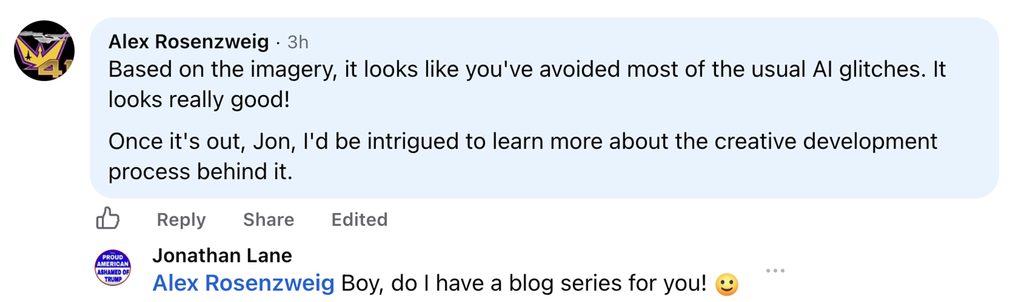
So I’ve decided to do a deep-dive into how I created some of the cooler shots for this fan film and how I managed to avoid some of the most common A.I. failures when it comes to rendering movie-era Star Trek. If that’s not your thing, then feel free to skip my next several blogs. I’ll be writing them specifically to help others, as I’ve learned that generative A.I. artists seldom keep their “tricks” secret and instead openly share the methods they used to achieve their results.
When last we left off, I had discovered that I needed to find actual stills of the USS Excelsior and adjust those—using a combination of both Google Gemini‘s free A.I. engine for generating images plus TONS of Photoshopping (often repeatedly for the same still). Then the time came to animate the lights turning on for the opening sequence. My tool of choice: Kling A.I. in order to learn what it could do. And it could do a LOT!
It could also screw up a lot…
Continue reading “How I made my ALL-A.I. Star Trek fan film NO ROOM FOR ERROR… (feature, part 2)”